
The problem with flat steel
A welding table needs to be flat. That's the whole point — you're using it to hold parts square while you join them, and if the surface moves under load, your datum is gone.
The obvious answer is a thick solid steel plate. Heavy enough, and it won't deflect. But this approach has a serious problem: the weight required to make a solid plate truly stiff at production scale is enormous. A solid 25mm plate cut to 2400×1200mm weighs over 600kg. You can't move it, you can't ship it economically, and you certainly can't assemble it in a typical workshop.
There's a better way. It's the same principle used in aircraft wings, engineered timber floors, and high-end furniture. It's called a torsion box — and it's the reason a BP table is flat, stiff, and flat-packed onto a standard pallet.
What is a torsion box?
A torsion box is a structural panel made from two flat faces connected by an internal lattice of ribs or webs. The ribs run in both directions, dividing the interior into a grid of cells — like a honeycomb, but made from flat sheet material.
The geometry is what makes it work. When a load is applied to the surface, the face plate tries to deflect locally. But it's bonded (or in BPT's case, interlocked and welded) to the internal ribs, which transfers that force into the structure as a whole. The ribs resist bending by acting in tension and compression simultaneously — the same way a steel I-beam works, except in two dimensions instead of one.
The deeper the box, the stiffer the structure. This is why the BPT tables use a 150mm-deep subframe. That depth is not arbitrary — it's where the structural efficiency makes the most sense for a fabrication-grade welding table.
How BPT implements it
Every BP table is CNC fibre laser cut from S275JR structural steel to ±0.2mm tolerance. The torsion-box subframe is a full-lattice design: laser-cut ribs interlock through the entire 150mm depth of the table using a tab-and-slot system, then are welded to form a permanent structure.
The tab-and-slot method is worth understanding. Each rib is cut with tabs that slot directly into corresponding holes in the adjacent ribs and face plates. Every component locates positively before welding begins. The result is a structure that assembles square because the parts are accurate — not because the assembler is careful. Welding locks that geometry in permanently.
Once assembled, the interlocked and welded lattice distributes any applied load across the entire subframe. Point loads — a heavy vice bolted through the fixture holes, a 200kg weldment clamped in the centre — spread into the structure rather than concentrating at the load point.
The numbers: the torsion-box construction achieves approximately 3,700× the stiffness of a solid plate of equivalent weight. That's not marketing language — it's a consequence of how second moment of area works in structural engineering. A deep, hollow box resists bending far more efficiently than a solid section of the same mass.
Why this matters for welding accuracy
Welding tables are used for fixturing: you clamp parts to the surface, weld them, and expect them to come out square. If the table deflects under the load of the fixture, your datum shifts. You compensate, you develop habits, you accept a margin of error you shouldn't have to accept.
A torsion-box table eliminates this. Because the subframe distributes load rather than absorbing it locally, the surface stays flat under realistic working loads. The 16mm fixture hole system on a 50mm pitch stays accurate — not just when the table is unloaded, but when you're actually using it.
This is also why surface plate thickness, while a real variable, matters less than most people expect. The plate is cut to ±0.2mm. The subframe keeps it flat. Upgrading from 6mm to 12mm changes the localised stiffness under point loads and the long-term wear characteristics — but the table's overall flatness and rigidity comes from the torsion box, not the plate thickness.
Choosing between 6mm, 8mm, 10mm and 12mm surface plates? Our thickness guide covers exactly what each option gives you — and which is right for your work.
How this compares to other welding table designs
Solid plate tables: Genuinely stiff, but only at impractical weights. A solid 20mm plate at production scale is not a workshop tool — it's a fixed installation. Expensive to move, expensive to ship, and still subject to thermal distortion.
Simple frame tables: A frame with a plate top. Cheap to manufacture. The plate is unsupported across most of its span, which means it deflects under load. Common on import tables at the lower end of the market.
Cast iron tables: Traditional choice for metrology and heavy machining. Accurate, thermally stable, but extraordinarily heavy and expensive. Not practical for most fabrication environments, and not compatible with MIG/TIG welding (cast iron and spatter don't mix well).
Torsion box: The structural performance of a much heavier solid plate, at a fraction of the weight. Ships flat-packed, assembles in a few hours, compatible with all standard clamping systems. The engineering solution for fabricators who need accuracy without the compromises of the alternatives.
The BP tables in practice
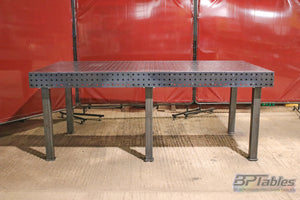
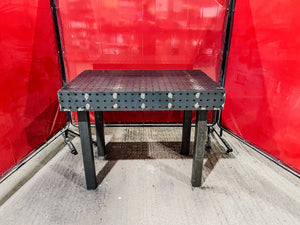
The Model L (2400×1200×150mm) and Model S (1200×800×150mm) are both built on the same torsion-box principle. The 150mm depth is consistent across both models — that's the dimension driving the structural performance.
Both tables use the same 16mm/50mm pitch fixture grid, making them compatible with the same clamping systems and accessories. The surface plate is available in 6mm (standard), 8mm, 10mm, or 12mm — a choice that adjusts the point-load performance and wear characteristics, while the torsion box handles the flatness.
See the BPT Model L — 2400×1200mm →
See the BPT Model S — 1200×800mm →