
The short answer
For most fabricators — home workshop or professional — 6mm is the right choice. It's the standard for a reason: it's stiff enough for the vast majority of welding and fabrication work, and it keeps the table at a weight you can actually move around a workshop.
12mm is a genuine upgrade, but it's one most buyers don't need. If you're unsure, read on — this article will tell you exactly which thickness makes sense for your setup.
First, understand what actually keeps a welding table flat
This is the part most comparison articles skip. When people ask about plate thickness, they're usually worried about deflection — will the table sag or spring under load? It's a fair concern. But the surface plate isn't what keeps a welding table rigid. The subframe is.
If you want to understand exactly how the torsion-box subframe works, we've written a full explainer: What is a torsion box welding table — and why does it stay flat?
The BP tables use a 150mm-deep full-lattice torsion-box subframe. Laser-cut ribs interlock through the entire depth of the table, distributing load across the whole structure. The result is a stiffness gain of approximately 3,700× compared to a solid plate of the same weight. That number isn't marketing — it's basic structural engineering. A deep, latticed box is orders of magnitude stiffer than a flat plate.
What this means in practice: the torsion box is doing the heavy lifting. The surface plate thickness affects localised stiffness directly under a load point — but the table as a whole stays flat because of the subframe, not because of how thick the top plate is.
Understanding this makes the 6mm vs 12mm decision much simpler.
What 6mm gives you
The standard 6mm surface plate is cut from S275JR mild steel to ±0.2mm tolerance. At that spec, it's the same material and process used across professional fabrication environments. Here's what it handles comfortably:
- General MIG, TIG and stick welding on structural steel
- Jig and fixture work with standard clamping loads
- Repetitive production runs — the table holds its datum shift to shift
- Components up to several hundred kilograms distributed across the surface
- Full compatibility with Demmeler, GPPH, Siegmund and all industry-standard 16mm/50mm pitch clamping systems
For the overwhelming majority of fabricators, 6mm does everything. Home welders, small fabrication shops, training centres, motorsport workshops — 6mm is the right call. It's also the lightest option, which matters when you're assembling the table solo or moving it between bays.
What 12mm gives you (and what it costs)
12mm is the maximum thickness available on both BPT models. It costs an additional £550 on the Model L and £350 on the Model S over the base price. For that, you get:
- Greater localised stiffness — reduced deflection directly under a point load (e.g. a heavy vice mounted to a single fixture point)
- Higher thermal mass — the plate takes longer to heat up under repeated passes, which can help with dimensional stability in high-cycle production environments
- More material for hard use — grinding, heavy clamping, dragging steel across the surface repeatedly. 12mm simply has more to give before wear becomes an issue
- Industrial signalling — if your table is going into a production facility that specifies plate thickness in procurement, 12mm ticks a box
What 12mm does not give you: a fundamentally flatter or more accurate table. The flatness comes from the laser-cut tolerance and the torsion-box subframe. A 6mm BP table is just as accurate as a 12mm one — the difference is in localised load performance and long-term wear.
The middle options: 8mm and 10mm
Both models also offer 8mm (+£150/+£100) and 10mm (+£300/+£250) surface plates. These are worth considering if:
- 8mm: You do a lot of vice or clamp-mounted work and want a bit more resistance under fixed-point loads, without the weight and cost jump to 12mm. A sensible upgrade for professional shops.
- 10mm: You're building a production welding cell, working with heavy structural sections regularly, or want the closest thing to 12mm performance at a lower price. Good for training centres that see hard daily use.
The honest recommendation
Here's how to decide:
Choose 6mm if: You're a home fabricator, a small professional shop, or setting up a first proper welding table. You weld general steel, do jig work, run fixtures. You want the best value-for-money precision welding table available. This is the right choice for 80% of buyers.
Choose 8mm if: You're a working professional who mounts heavy vices or clamps repeatedly in the same spots and wants a bit more meat under the most-used areas. A straightforward upgrade that most pros would justify.
Choose 10mm if: You're running a busy production or training environment, your table takes a beating daily, and you want serious long-term durability without going full industrial spec.
Choose 12mm if: You're specifying for a professional production facility, you need to meet procurement criteria, you're doing extremely heavy repeated clamping loads, or you simply want the best available and the price difference isn't a deciding factor.
In all four cases, the torsion-box subframe is doing the structural work. You're buying a different surface spec, not a fundamentally different table.
Model L vs Model S — does thickness choice change by model?
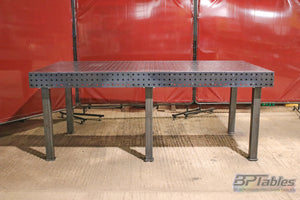
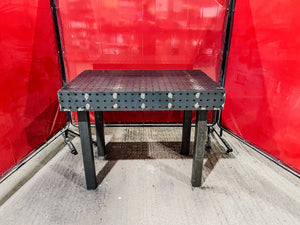
The same four thickness options are available on both the Model L (2400×1200mm) and Model S (1200×800mm). The upgrade prices are slightly lower on the Model S because there's less material involved — that's the only difference.
If you're still deciding between the models themselves, the size of your workshop and the scale of your projects should drive that decision, not the thickness. Both tables are built to the same spec, from the same steel, on the same CNC fibre laser.
Still not sure?
If you're genuinely torn, order the 8mm. You can always spec up if you're replacing a table in the future and have a specific reason to do so. But most fabricators who order 8mm never wish they'd gone thicker — the torsion-box construction means the table performs well beyond what the surface plate thickness alone would suggest.
Questions about your specific setup? Get in touch — James will give you a straight answer.
See the BPT Model L — 2400×1200mm →
See the BPT Model S — 1200×800mm →