UK Welding Table Buyer's Guide
If you're comparing welding tables and your head is spinning — you're not alone. We speak to fabricators, hobbyists, and training workshops across the UK every week, and the same questions come up time and again. This guide answers them honestly, with the technical detail that actually matters. Whether you buy from us or not, we want you to walk away knowing exactly what to look for.
How to choose the right table size
Start with your work — not the table. The right size is determined by the largest job you regularly do, not the largest job you'll ever do.
One rule of thumb worth keeping: your working surface should comfortably accommodate at least 75% of your most common workpiece in a single setup. If you have to hang half the job off the end of the table, you lose the benefit of having a flat datum in the first place.
| Model | Surface | Best suited for | Load | From |
|---|---|---|---|---|
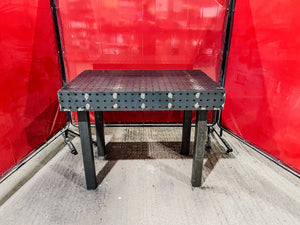
| XS | 1000×1000mm | Home garage, jigs, brackets, tight spaces, mobile setups | 500kg | £549 |
| S | 1200×800mm | Home workshop, TIG bays, stainless, motorcycle & auto | 750kg | £799 |
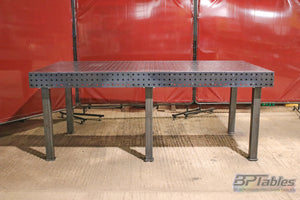
| L | 2400×1200mm | Professional shops, chassis, structural, training centres | 1,500kg | £1,799 |
| XL | 3000×1500mm | Heavy plate, industrial production, large-frame fabrication | 5,500kg | £3,350 |
A few things to account for that most guides skip:
- Assembly weight vs delivery weight — flat-packed panels are manageable. An assembled Model L is approximately approximately 400kg. Decide where it lives before you build it, because it won't move easily afterwards.
- Doorway and access — flat-packed, BPT tables pass through a standard doorway. Assembled, the Model L is 2400mm long. Check your access route.
- Leg height — standard working height is 900mm (standing). If you prefer seated or lower work, 750mm is common. Add your preferred height in the checkout order notes.
- Expansion — BPT tables bolt together on any face. Two Model L tables give you a 2400 × 2400mm surface without buying a custom table.
What if you outgrow your table later?
You don't need to guess the largest size you'll ever need up front. The Model L takes a bolt-on extension on any side, so you can start with the standard 2400 × 1200mm and grow the table later instead of replacing it.
The extension comes in two lengths, matched to the two sides of the table: 1200mm to extend a short end, or 2400mm to extend a long side. Fit one, or fit two for a bigger jump:
- Two 1200mm extensions on the short ends → 3200 × 1200mm
- Two 2400mm extensions on the long sides → 2400 × 2000mm
Each extension matches the main table's 150mm torsion-box depth, 16mm hole grid and CNC laser-cut S275 steel, and is available in the same surface plate thicknesses so it sits flush and continues the fixturing pattern without a gap at the join.
Should you buy a 16mm or 28mm fixture hole system?
This is one of the most confusing decisions for first-time buyers, and the answer is simpler than the industry makes it look.
16mm/50mm pitch is the open standard. It was established by the German tooling industry decades ago and adopted by every major manufacturer who wasn't trying to lock customers into a proprietary system. Demmeler, GPPH, hundreds of independent tooling makers, and all BPT tables use 16mm holes on a 50mm grid.
28mm/100mm pitch is Siegmund's premium system, used primarily on their System 28 range. It accepts more tooling variety at the very top of the market, but it is a closed ecosystem — 28mm tooling doesn't fit 16mm tables, and vice versa.
| 16mm / 50mm pitch | 28mm / 100mm pitch | |
|---|---|---|
| Hole diameter | Ø16mm | Ø28mm |
| Grid spacing | 50mm centres | 100mm centres |
| Tooling ecosystem | Open standard — multiple brands compatible | Primarily Siegmund proprietary |
| Clamping positions (1200mm span) | 24 positions | 12 positions |
| Entry tooling cost | Lower — competitive market | Higher — limited competition |
| UK tooling availability | Wide — most UK suppliers stock 16mm | Limited — mainly via Siegmund UK |
| Suitable for | Everyone — the sensible default | Large shops already in the Siegmund ecosystem |
The pitch difference matters more than it sounds. On a 1200mm span, a 50mm grid gives you 24 possible clamping positions. A 100mm grid gives you 12. When you're trying to locate a 60mm bracket, or position two stops 175mm apart, those extra positions matter.
There's also a tooling compatibility risk with 28mm that's often overlooked: if you buy 28mm now and decide to switch brands later, your entire tooling collection is stranded. With 16mm, you can mix clamps from Demmeler, GPPH, BPT, and any number of independent suppliers without compatibility issues.
Do you need a 5-face fixture system?
Five-face means fixture holes on all five working surfaces: the top surface and all four vertical skirts. It sounds like a premium extra — it isn't. It's the difference between a table and a datum surface.
Without side holes, you can only clamp from above. Every time you need to locate a component against the side of the table — a tube held vertical, a stop bar running the length of the edge, a frame member locked against the skirt — you're improvising with vise grips or packing pieces. That's fine occasionally. It's frustrating daily.
With 5-face coverage, the entire table becomes a clamping surface:
- Frame fabrication — locate horizontal members against the top, lock vertical members against the side skirt
- Edge datum stops — bolt a stop bar to the skirt face, run components flush against it
- Angle plates — mount directly to the side holes for 90° reference surfaces
- Vice mounting — bolt a vice to the end skirt, get a clamping surface at table height without a separate stand
- Through-fixing — pass a bolt from the side face through to a clamping point on the top surface
BPT Model XS, S, and L tables all carry the 16mm/50mm fixture grid on all five faces as standard. The Model XL carries fixture holes on the top face and all skirts, with a 28mm/100mm pitch on the top surface.
Why flatness matters more than anything else
Surface flatness is the most important specification on a welding table. It's also the specification most manufacturers are vague about — because it's the one that separates a real welding table from a workshop bench with holes drilled in it.
Here's what actually happens when you work on a 2mm out-of-flat surface:
- You lay a 1200mm tube across the surface. Because the surface has a 2mm bow, the tube rocks slightly — you might not even notice.
- You tack-weld it in place. The weld locks the tube with a slight deviation absorbed into the joint.
- You add the second member and reference off the first. It looks correct relative to the first — but both are skewed relative to a true datum.
- The finished frame has 1.5–2mm of accumulated twist locked in.
On a ±0.2mm surface, step 1 is: the tube sits flat. Step 2: the tack locks it in place flat. The frame comes off flat.
This cascading error compounds across complex assemblies. On a simple two-tube frame the effect is minor. On a four-point chassis with multiple intersecting members, 2mm of initial error can produce 8–10mm of accumulated distortion by the time you've finished welding.
The real-world cost of poor flatness isn't just rework — it's the time you spend trying to work around a surface you can't trust. That time adds up faster than the price difference between a cheap table and a proper one.
To put ±0.2mm over 2400mm in context: that's 1 part in 12,000 — the same order of accuracy as a quality machine tool bed. It's not marketing. It's the result of CNC fibre laser cutting where every component is dimensioned from the same digital datum before a single component is cut.
What makes a welding table stay flat?
Starting flat and staying flat are two different things. Initial flatness is a manufacturing question. Long-term flatness retention is a structural engineering question.
1. The torsion-box principle
A torsion box achieves far greater stiffness than a solid plate of the same weight — because stiffness is proportional to depth cubed, not depth linearly.
Consider a 6mm solid plate vs a torsion box 150mm deep. The depth ratio is 25:1. Stiffness ratio is approximately 25³ = 15,625 — corrected for the fact that the box is hollow, the real improvement is around 3,700×. That number is BPT's measured stiffness gain for the specific rib geometry used in our tables.
This is why upgrading from a 6mm table to an 8mm solid plate adds modest stiffness, while a 150mm torsion box at 6mm dramatically outperforms both.
2. Interlocking ribs vs welded ribs
The ribs inside a BPT table don't just sit next to each other — they pass through each other at every intersection, locked by the tab-and-slot system. This means load on any single rib is immediately distributed to all connected ribs in both axes. There's no weak point, no single member that deflects in isolation.
A table with ribs only butt-welded at intersections behaves differently: the joints are the weak point, and over years of use they can relax. An interlocking structure has no joints to relax — the geometry is mechanical, not welded.
3. How the assembly method affects final flatness
BPT tables are delivered flat-packed and welded by the customer. Some buyers see this as a limitation. It isn't — it's the correct approach for this type of table. (Assembly is available as an option if you'd prefer a ready-built table — contact us for details.)
The tab-and-slot system means the table is mechanically square before the first weld goes in. The customer isn't trying to achieve flatness with welds — the welds are just locking in geometry that already exists. This is more reliable than a factory weld that may carry heat distortion from the assembly process.
4. What doesn't keep a table flat
Surface coatings — paint, powder coat, nitriding — have no structural role. They protect the surface but do nothing for long-term flatness. A nitrided table that was slightly warped when it left the factory will remain slightly warped under the nitriding. The flatness comes from the manufacturing, not the finish.
Is S275 steel enough for a welding table?
Yes. And the reason it's enough is worth understanding, because the marketing around steel grades in welding tables is consistently misleading.
S275JR to EN10025-2 is structural steel — the same grade used in bridges, building frames, and crane booms. Its certified minimum properties:
| Property | S275JR | S355J2 | What it means for tables |
|---|---|---|---|
| Yield strength | ≥275 MPa | ≥355 MPa | S355 is 29% stronger at yield point |
| Tensile strength | 430–580 MPa | 490–630 MPa | S355 is marginally stronger in tension |
| Elongation | ≥23% | ≥22% | Both are highly ductile — won't brittle-fracture |
| Weldability | Excellent | Good — requires care at higher thicknesses | S275 is marginally easier to weld |
| Typical price uplift | — | ~10–15% more | S355 tables cost more for marginal structural gain |
Here's why S355 doesn't meaningfully improve a welding table:
The relevant failure modes for a welding table top plate are: (1) fixture holes deforming under clamping force, and (2) the surface deflecting under a concentrated load. For (1): the deformation load for a 16mm hole in a 6mm S275 plate is several tonnes — orders of magnitude beyond any realistic clamping force. For (2): plate deflection under a distributed load is determined by the subframe geometry, not the yield strength of the surface plate.
The thing that determines whether a table sags under a heavy workpiece is the torsion-box depth and rib geometry. That's a structural design question, not a materials question. A S275 torsion box outperforms a S355 solid plate in every load case relevant to welding tables.
What does matter with steel grade is certification. "Mild steel" or "carbon steel" without a standard number and mill cert is not a specification — it's an invitation to buy whatever was cheapest that week. BPT uses S275JR with EN10025-2 certification. You can ask for the mill cert.
How much weight can a BPT table actually hold?
Short answer: a lot more than most fabrication work will ever ask of it. The torsion-box subframe that keeps the surface flat under a clamped weld also gives the whole table serious static load capacity — not just at the fixture holes, but across the surface.

That's one of our own tables, deliberately loaded up as a demonstration — not a routine daily use case. But it's a real tractor, no rigging tricks, sat entirely on the table on its own wheels. It's a useful illustration, but the number that actually matters is the rated static load per model, tested and published, not a one-off photo:
Those figures come from the torsion-box depth and rib geometry, not the top plate — the same structural principle covered above. A deeper, well-triangulated subframe distributes load across the whole surface instead of concentrating it under one clamp or one wheel, which is why the rating scales with table size and subframe depth rather than top thickness alone.
UK vs imported welding tables — an honest comparison
The UK market breaks into three distinct categories. Understanding them makes the buying decision straightforward.
Category 1 — Budget imports (£150–400)
Sold primarily on Amazon and eBay, usually shipped from Chinese manufacturers. The listings use professional photography and technical-sounding copy, but the underlying product is typically:
- Steel grade: unspecified. "Mild steel" or "carbon steel" is not a standard. There's no mill cert. Composition, hardness, and flatness are all unknown variables.
- Flatness: typically ±2mm or no published specification. 10× worse than BPT. The manufacturing process (press-formed or rolled plate) doesn't achieve laser-cut accuracy.
- Fixture system: often absent, or non-standard hole patterns that don't accept any recognised clamping system.
- Lead time: 2–6 weeks. UK sellers order from stock shipped from China via sea freight.
- Support: none. You're dealing with a marketplace seller. If there's a problem, you're navigating Amazon returns or a non-UK email address.
These are workshop benches being marketed as welding tables. They're fine as a flat surface. They're not a datum.
Category 2 — European premium brands (£1,500–8,000+)
Siegmund (Germany), GPPH (Poland), Demmeler (Germany), and Maktek (Czech Republic) make genuinely excellent tables. If budget isn't a constraint and you want the top of the market, these are legitimate options. But for the UK buyer in 2026, several factors complicate the purchase:
- Post-Brexit import duty: tables from EU countries now attract UK import duty. For a £3,000 Siegmund table, that's a material addition to the landed cost. UK distributors price this in — which is why the UK list prices are significantly higher than the EXW prices on European websites.
- Lead time: 4–12 weeks ex-works, plus UK shipping and customs clearance. For a busy workshop, that's a significant wait.
- Hole system: Siegmund System 28 uses 28mm/100mm — a proprietary standard. If you buy a Siegmund table, you're committed to buying Siegmund tooling (or compatible third-party tooling, which is limited).
- Support: UK distributors vary in quality. Direct support from the German or Polish manufacturer means navigating language and time zone differences.
Category 3 — UK-made (BPT)
- Steel: S275JR to EN10025-2, sourced and cut in the South-West of England. Mill cert available.
- Flatness: ±0.2mm — better than European alternatives at this price point.
- Fixture system: 16mm/50mm — the UK workshop standard, compatible with most tooling already in UK shops.
- Lead time: 5–7 working days. In stock, cut to order, dispatched on pallet.
- Support: direct from the maker. We're in Taunton. You can call us.
- Price: from £549 (XS) to £3,350 (XL). Model L at £1,799 vs equivalent Siegmund at £4,000–6,000+.
| Budget import | BPT (UK) | European premium | |
|---|---|---|---|
| Steel certification | None | EN10025-2 S275JR | S355J2 |
| Surface flatness | ±2mm or unpublished | ±0.2mm | ±0.5mm |
| Fixture system | None or non-standard | 16mm/50mm open standard | 28mm/100mm (proprietary) |
| UK lead time | 2–6 weeks | 5–7 days | 4–12 weeks + customs |
| Import duty (post-Brexit) | May apply | None — UK made | Applies from EU |
| Starting price | £150–400 | From £549 | From £1,500 |
Common mistakes buyers make
These come directly from conversations with fabricators who've already bought the wrong thing and come back for the right one.
The £200 table on Amazon looks like a bargain. Within six months you're spending more time shimming and correcting than you are fabricating. The cost of poor flatness isn't the purchase price — it's the hours you spend working around a surface you can't trust.
Mild steel is a category, not a specification. It can mean almost anything. Ask for the steel grade and the mill cert. If they can't provide it, the table is unverified — which means the flatness retention, weldability, and structural integrity are all unknowns.
Buying a 28mm table with no 28mm tooling — then discovering most UK suppliers don't stock 28mm clamps — is a common and expensive mistake. Check your existing tooling. If you have 16mm clamps or are starting from scratch, buy a 16mm table.
Almost every fabricator who's owned a table for a year wishes it were bigger. The exception is rare. When you're deciding between two sizes, go up. The cost difference is usually modest relative to the table's working life.
It looks good in the product photo. Within a few months of active welding, heat has burned through the coating in patches, and you have bare steel exposed at the edges where moisture gets under the paint. Raw oiled finish handles this correctly: no coating to burn off, no trapped moisture, clean with a wire brush.
Flat-packed panels are manageable. An assembled Model L is approximately 400kg. Decide exactly where it lives before you build it — because moving it later requires either disassembly or machinery. Also: check your floor loading if you're on a suspended floor.
A welding table without clamps, stops, and squares is a very expensive flat bench. Budget for at least a starter kit of 16mm tooling when you buy the table. The 16mm ecosystem is available at all price points — you don't need to buy premium clamps, but you need some clamps.
The cost of the cheap table isn't just the purchase price — it's every hour of rework it causes, and then the cost of the proper table you eventually buy anyway. Many fabricators end up buying two tables: the cheap one first, and then the right one. Just buy the right one.
Which welding table is best — for beginners, hobbyists, or professionals?
The honest answer is that the fundamentals don't change much between skill levels. Anyone doing serious welding needs a flat, stable surface with a proper fixture hole system. The difference is usually about size, weight, and budget — not the underlying quality requirements.
- Home workshop / hobbyist: the Model XS (1000×1000mm, £549) or Model S (1200×800mm, £799) — both give you a proper ±0.2mm datum in a format that fits a single-bay garage or small unit. Don't be tempted by a cheap import. The XS and S are the entry points into real precision, not a compromise.
- Single-operator professional: Model S or Model L depending on the work. If you're doing chassis work, pipe fabrication, or anything longer than 1000mm regularly, go straight to the Model L.
- Workshop or training centre: Model L as the baseline, with room to bolt a second L alongside it. Two Model L tables give you 2400 × 2400mm of connected, flat datum surface.
- Industrial production: Model XL (3000×1500mm, £3,350) with 5,500kg load rating and 12mm surface plate.
The key thing to avoid at every level: cheap import tables from Amazon or eBay. Surface tolerances of ±2mm or worse, no proper fixture hole system, and thin unspecified steel. They're a false economy — the time cost of working around poor flatness far exceeds the price difference.
How thick should the top plate be?
For most UK fabrication work, 6mm is the correct starting point. The surface plate thickness is just one variable — what matters is the system it sits on.
BPT's torsion-box design uses a 150mm-deep interlocking rib structure beneath the surface plate. The result is a stiffness gain of approximately 3,700× compared to a solid plate of the same weight. A 6mm plate on a 150mm torsion box outperforms a 12mm solid plate in every relevant deflection test.
Upgrading the surface plate makes sense in specific cases:
- 8mm — enhanced local stiffness and reduced surface deflection under concentrated clamp loads. Suitable for heavy production environments
- 10mm — heavy-duty pro use, regular press or high-force clamping work
- 12mm — maximum stiffness, industrial reference applications, sustained heavy load
BPT Model S and L offer all four thicknesses. If you're unsure, choose 6mm — it's the option chosen by the majority of professional workshops, and you can always start there.
Do you need a nitrided or heat-treated welding table surface?
Almost certainly not. This is one of the most persistent areas of marketing fluff in the welding table industry.
Nitriding does harden the surface layer of mild steel — from around 12 HRC to 46–60 HRC depending on treatment depth and quality. But the hardened layer only penetrates to a depth of 0.0004–0.0012 inches (roughly 0.01–0.03mm). To put that in perspective: a single sheet of tissue paper is approximately ten times thicker than the hardened zone nitriding produces.
What you have is an extremely thin, hard shell over a soft steel core. It resists light surface scratching. The moment anything impacts the surface with meaningful force — a dropped clamp, a hammer blow, dragging a heavy plate across it — you're through that shell and into the base steel underneath.
Nitriding is also micro-porous. Over time, the micro-pores can trap moisture against the base steel, accelerating localised corrosion beneath the surface. The cracks that develop at impact sites also provide moisture ingress points.
Here's a fact that's rarely mentioned: a freshly applied film of WD-40 Specialist Corrosion Inhibitor outperforms nitriding alone in standard salt-spray corrosion testing — often by an order of magnitude. A £10 aerosol beats a premium surface treatment for actual corrosion protection.
What BPT does instead: we supply our tables with a raw oiled finish — the traditional approach used by fabricators for generations. A light coat of oil applied periodically gives genuine corrosion protection you can refresh at any time. Welding spatter doesn't bond to it. It cleans in seconds with a wire brush. No thin shell. No marketing claims.
What finish should a welding table have?
For active welding use, raw oiled finish is the right choice — and it's what BPT supplies as standard. Here's why:
- Painted or powder-coated surfaces burn off under welding heat, produce fumes from the burning coating, and leave bare metal patches exposed at the exact points where moisture and spatter collect. The coating edge is also a moisture trap that accelerates rust.
- Nitrided surfaces are thin, brittle shells. See above.
- Raw oiled finish means the steel surface is clean, flat, and protected by a thin oil film that you apply and maintain. Weld spatter sits on top of the oil film and comes off with a wire brush. The surface can be refreshed with any penetrating oil at any time. It's not glamorous. It works.
The practical routine: before each welding session, apply anti-spatter spray (Rocol, Ambersil, or similar) to the table surface. After the session, wire brush any residue. Monthly: wipe over with a rag and light oil. That's the entire maintenance programme for a BPT table.
How does BPT compare to European brands like Siegmund or GPPH?
Honestly — very well for the UK market specifically. European brands like Siegmund (Germany) and GPPH (Poland) make excellent tables, but they carry a significant price premium, extended lead times, post-Brexit import complications, and a different fixture system.
The one area European brands have an edge is surface plate thickness at the top end — Siegmund offers up to 15mm surface plates for industrial reference applications. BPT's maximum is 12mm, which covers 99% of UK fabrication requirements.
On every other dimension that matters for the UK market:
- Price: BPT Model L at £1,799 vs equivalent Siegmund at £4,000–£8,000+
- Lead time: 5–7 days (BPT) vs 4–12 weeks plus customs (Siegmund/GPPH)
- Fixture system: BPT uses 16mm/50mm — compatible with most UK workshop tooling. Siegmund System 28 requires dedicated tooling that doesn't work on 16mm tables.
- Import duty: BPT is UK-made — no import duty. EU tables now attract tariffs under post-Brexit UK trade rules.
- Flatness: BPT ±0.2mm vs Siegmund ±0.5mm — BPT is actually tighter.
How is a BPT table delivered, and how long does assembly take?
BPT tables are delivered flat-packed on a wooden pallet via our UK pallet network. Standard dispatch is 5–7 working days.
The flat-pack design is intentional engineering, not a cost-cutting measure. A fully assembled 2400 × 1200mm table would be practically impossible to handle in a domestic or small workshop setting. Flat-packed, the components move through a standard doorway and assemble in situ.
Assembly uses a tab and slot interlocking system — every panel locates positively before a single weld goes in. Most customers complete a solo Model S build in under 2 hours, and a Model L in 3–4 hours. Full step-by-step instructions are on our assembly guide page. Prefer a ready-built table? We offer an assembly service — get in touch.
Can I get a custom size?
Yes. We offer bespoke tables in non-standard sizes, heights, and configurations. Custom work typically adds 2–4 weeks to lead time. Contact us with your requirements and we'll come back with a quote.
We also run a full custom laser cutting service from the same workshop — useful if you need one-off tooling plates, brackets, or fixturing components to complement your table.
Is finance available?
Yes. BPT offers Klarna 3× interest-free payment on all orders, splitting the cost into three equal monthly payments with no interest.
- Model XS — £549 → 3 × £183.00/month
- Model S — £799 → 3 × £266.33/month
- Model L — £1,799 → 3 × £599.67/month
- Model XL — £3,350 → 3 × £1,116.67/month
For trade or volume enquiries, contact us directly. We offer trade pricing for multiple-table orders and educational institutions.
Four models. One standard of precision.
All BPT tables ship in 5–7 days with UK pallet delivery. Klarna 3× interest-free available on every order.
Still not sure? Use the chatbot on site or contact us directly — we're in Taunton and happy to talk through your requirements.