
The short answer
No. For a welding table, S275 is not a compromise - it's the correct material, and the extra yield strength S355 offers doesn't translate into a better table. If a supplier is using "S355" as a reason to charge more or to imply their table is stronger, that's a marketing claim, not an engineering one.
Here's the actual physics behind that answer.
What the numbers actually say
S275JR and S355J2 are both structural steel grades to EN10025-2 - the same standard used for bridges, building frames and crane booms. Here's how they compare on paper:
| Property | S275JR | S355J2 | What it means for tables |
|---|---|---|---|
| Yield strength | ≥275 MPa | ≥355 MPa | S355 is 29% stronger at yield point |
| Tensile strength | 430–580 MPa | 490-630 MPa | S355 is marginally stronger in tension |
| Elongation | ≥23% | ≥22% | Both are highly ductile - neither will brittle-fracture |
| Weldability | Excellent | Good - requires more care at higher thickness | S275 is marginally easier to weld |
| Typical price uplift | - | ~10-15% more | S355 tables cost more for a gain that doesn't apply here |
On paper, S355 looks like the better material. In a welding table, it isn't — because a welding table never gets close to loading either grade anywhere near its yield point.
Why the extra strength doesn't matter
There are only two failure modes worth worrying about on a welding table top plate: the fixture holes deforming under clamping force, and the surface deflecting under a concentrated load.
Fixture holes: the load required to deform a 16mm hole in a 6mm S275 plate is measured in tonnes - several orders of magnitude beyond anything a toggle clamp, screw clamp or fixture bolt can apply. Both S275 and S355 have enormous headroom here. Upgrading the steel grade to protect against hole deformation is solving a problem that doesn't exist.
Surface deflection: whether a table sags under a heavy workpiece is a function of the subframe's stiffness, not the yield strength of the surface plate. A thin, unsupported sheet of S355 will still flex more than a thick, well-supported sheet of S275 sitting on a deep torsion box. Steel grade is the wrong variable to look at.
We've written a full explainer on the part that actually does the structural work: What is a torsion box welding table — and why does it stay flat? The short version: a laser-cut, full-lattice torsion-box subframe distributes load across the entire structure. That's a geometry problem, not a materials problem - and a well-designed S275 torsion box will outperform a flat S355 plate in every load case relevant to fabrication work.
Where S355 genuinely earns its keep
To be fair to the grade: S355 is the right call in applications where components are loaded close to their yield point - long-span structural beams, crane booms, load-bearing building frames, heavy plant chassis. In those cases, the extra 29% yield strength lets an engineer specify thinner or lighter sections for the same load rating, which matters when weight and material cost scale with a structure's size.
None of that applies to a welding table top. A table surface isn't spanning a structural gap under design load - it's a flat working surface sitting on a subframe built specifically to keep it rigid. The conditions where S355's advantage shows up simply don't occur here.
What actually matters: certification, not grade
If steel grade isn't the deciding factor, what is? Certification. "Mild steel" or "carbon steel" quoted without a standard number and a mill certificate isn't a specification - it's an invitation to buy whatever was cheapest that week, from whichever mill, with no guarantee of consistent mechanical properties.
BPT tables are cut from S275JR to EN10025-2, with mill certification available on request. That's a known, traceable, consistently-performing material - which matters far more for a precision fixture surface than a marginal yield-strength uplift you'll never load anywhere near.
Key takeaway: S275JR is not a compromise - it's the correct, certified material for a welding table. The structural performance of your table comes from torsion-box depth and geometry, not from whether the plate is S275 or S355. Anyone implying otherwise is marketing, not engineering.
The honest recommendation
If you're comparing welding tables and see "S355" listed as a headline feature, ask what problem it's actually solving. If the answer is "it's stronger steel" without reference to fixture-hole deformation or subframe deflection, it's a marketing line - the grade upgrade doesn't change how the table performs in use.
What you should actually be checking: is the steel certified to a named standard (EN10025-2 or equivalent), is the mill cert available, and how deep and how well-triangulated is the subframe underneath the plate. Those answers tell you far more about how the table will perform than the grade stamped on the plate.
Questions about your specific setup? Get in touch - James will give you a straight answer.
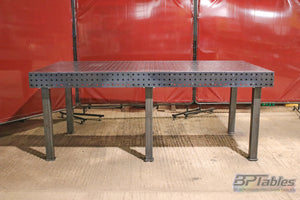
See the BPT Model L — 2400×1200mm →
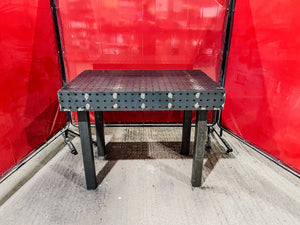
See the BPT Model S — 1200×800mm →