
The short answer
Every welding table brand on the market would love you to believe stiffness comes from a thick top plate and a name that's hard to pronounce. It doesn't. It comes from geometry, and geometry has never once cared what language your logo is in.
The rib and sidewall structure underneath the top plate determines how stiff a welding table actually is, by a very wide margin. That's not opinion, it's Euler-Bernoulli beam theory: a beam's resistance to bending is proportional to its depth cubed, but only linear to its thickness. Depth wins by an order of magnitude before you've even changed material.
Every number in this post is either a published BPT spec or a publicly stated Siegmund spec. Check it yourself. We're not precious about it.

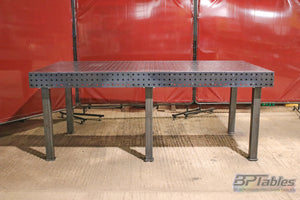
This is what actually decides how stiff a Model L is. Not the top plate sitting on top of it.
The physics
The Area Moment of Inertia, the geometric property that determines a beam's bending stiffness, is calculated as:
I = b × h³ / 12
where b is the material thickness and h is its depth. Multiply that by the material's elastic modulus (Hooke's Law) and you get bending stiffness. The important part: h is cubed. b isn't. A rib that's twice as deep is eight times stiffer for the same thickness of steel. A rib that's twice as thick is only twice as stiff. If you want a stiffer table, don't reach for thicker steel. Reach for a taller ruler.
This is the entire argument. Everything below is that one equation applied to real numbers.
Rib depth: BPT's own numbers
BPT's torsion-box depth scales with table size, not because it looks proportional on a spec sheet, but because longer spans need more depth to stay flat under load:
| Model | Rib/subframe depth | Rib thickness | Relative stiffness per rib | Steel used per rib |
|---|---|---|---|---|
| Model XS | 50mm | 6mm | Baseline | Baseline |
| Model S / Model L | 150mm | 6mm | 27× | 3× |
| Model XL | 200mm | 12mm | 128× | 8× |
Tripling the rib depth from XS to L (50mm to 150mm) at the same 6mm thickness gives 3× the steel and 27× the bending stiffness, exactly what (150/50)³ predicts. The XL's 200mm, 12mm ribs use 8× the steel of the XS and return 128× the stiffness, because both depth and thickness scale up together on the largest table.
Key takeaway: Tripling the rib depth doesn't triple the stiffness, it multiplies it by 27, for 3× the steel. Rib depth is the lever that actually matters, and it's the number most welding table spec sheets don't lead with.

A Model L subframe mid-build, top plate not yet fitted. Every one of those cells is a rib, and every rib is doing structural work the spec sheet doesn't show.
Rib spacing: the second lever
Depth isn't the only variable. How far apart the ribs sit changes how much the top plate, and the whole structure, sags between them, and that scales with span cubed too, the same equation running the other way.
BPT's XS, S and L models space ribs every 200mm. The Model XL, with deeper 200mm/12mm ribs doing more work per member, spaces them at 400mm, a deliberate trade of member count for member depth, not an oversight.
Siegmund publish their own numbers too. Their System 16 sidewall measures 3.94″ × 0.47″: that's 100mm deep, 12mm thick in real units. Their System 28 catalog states rib spacing of approximately 500–600mm.
| BPT (S / L) | Siegmund (published) | |
|---|---|---|
| Rib depth × thickness | 150mm × 6mm | 100mm × 12mm (System 16) |
| Per-rib stiffness (I) | 1,687,500mm⁴ | 1,000,000mm⁴ |
| Steel per rib (cross-section) | 900mm² | 1,200mm² |
| Rib spacing | 200mm | 500–600mm (System 28) |
Per rib, BPT's 150mm-deep, 6mm-thick member is about 1.7× stiffer than Siegmund's own stated System 16 sidewall, using around 25% less steel to do it. Same principle: taller and thinner beats shorter and thicker. Nobody puts that on a brochure because it doesn't sound as impressive as "precision engineered."
Then space them closer together. Over a 2400mm run, the length of a Model L, BPT's 200mm spacing fits 12 ribs. At Siegmund's own published 500–600mm System 28 spacing, the same run fits around 4. Multiply per-rib stiffness by rib count and BPT's structure across that span works out to roughly 4.5× the combined resistance to bending and twist, using less steel per member to get there.
We're comparing across two different Siegmund product lines here, System 16's sidewall dimensions and System 28's rib spacing, because those are the only two figures Siegmund publish. If anything that understates the case, since System 28 is their flagship line, priced accordingly.

The view from underneath: rib after rib, closely spaced, doing the work a thicker top plate never could.
Key takeaway: Torsional rigidity, what stops a corner-loaded table twisting your work out of square, comes from the same two numbers: how stiff each rib is, and how many are fighting the twist. On both, using Siegmund's own published figures, BPT comes out ahead.
What about the top plate?
The top plate matters for local flatness right under a clamp, between two ribs. Thickness and span both apply here too, cubed. BPT's standard top is 6mm on 200mm rib centres, thinner than some competitors quote, but the span term does most of the work. Halving the gap between ribs has a bigger effect on local flatness than doubling the plate thickness, for the same reason the ribs do: cubed terms dominate linear ones. A thick top plate over a wide gap is just an expensive way to look confident.
If you want more anyway, the Model S and Model L are available with 8mm, 10mm or 12mm top plate as an upgrade, on the same subframe underneath: you're not paying for a different table, just a thicker skin on the same rib structure. The Model XL ships with a 12mm top as standard.
The solid-plate comparison
Here's the number that makes the whole argument concrete. Take a 200mm-wide strip of a Model L with the 8mm top-plate upgrade: an 8mm plate welded to a 150mm-deep, 6mm-thick rib underneath, working together as a single composite beam. Run that through the same beam-theory maths as the rest of this post and its bending stiffness works out to about 5.29 million mm⁴.
Now ask how thick a single flat sheet of steel, no ribs, nothing underneath, would need to be to match that same stiffness at the same width. Solve I = b × h³ / 12 in reverse and the answer is about 68mm. Not 8mm. Not 20mm. Sixty-eight millimetres of solid plate to bend exactly as little as an 8mm top on a proper rib structure.
A full Model L, top plate, ribs, sidewalls, legs, the lot, weighs about 380kg fully assembled. A solid plate matched to just the top-plate-and-rib bending stiffness would weigh in the region of 1.5 tonnes on its own, nearly four times the weight of the entire finished table, and that's before you've fitted a single leg. Nobody is getting that through a workshop door, let alone levelling it by hand.
Key takeaway: An 8mm top plate on a proper rib structure is already the stiffness equivalent of a 68mm solid slab, for about a fifth of the steel. Rib depth and spacing aren't a nice-to-have next to top-plate thickness, they're doing roughly five times the structural work per kilogram.
Does steel grade matter?
Not for stiffness. Every structural steel, S275JR, S355J2, anything else you'll find on a mill certificate, shares almost exactly the same elastic modulus, around 200 GPa. Stiffness is a function of that modulus and the geometry sitting on top of it. You can buy a fancier alloy. You can buy a fancier badge for the corner of the table. Neither one bends less under load.
What steel grade actually buys you is resistance to permanent damage: yield strength, not stiffness. BPT tables use S275JR structural steel to EN10025-2, certified, mill cert available on request. Siegmund's own pages list S355J2+N for their structure, a higher-yield grade than ours, on paper.
We've written a full explainer on why that doesn't change the buying decision: S275 vs S355, does your welding table actually need the stronger steel? Short version: the loads a welding table top actually sees, clamp pressure on a fixture hole, a workpiece resting on the surface, are nowhere near either grade's yield point. The extra 80 MPa Siegmund's steel offers over ours is real, and it's also irrelevant to how flat your table stays or how it performs in use, because that's a geometry question, not a yield-strength question.
Key takeaway: Elastic modulus doesn't change between steel grades. Stiffness is bought with rib depth, thickness and spacing, full stop. Yield strength is a separate spec that matters for dent resistance, not flatness, and BPT's certified S275JR is more than the loads involved require.
The honest recommendation
If a welding table's marketing leads with top-plate thickness and stays quiet about rib depth and rib spacing, that's worth noticing: those two numbers are what the top plate sits on, and they do most of the structural work. Ask for them in mm. If a supplier won't give you rib depth and spacing, that's the spec they don't want you comparing. Ask us too, we'll just tell you.
Every figure in this post came from BPT's own published dimensions or Siegmund's own stated specs. Check the maths, ask us for anything we haven't shown, and compare it against whatever you're looking at. We'll still be here.
Questions about your specific setup? Get in touch, and James will give you a straight answer, no accent required.
See the BPT Model L, 2400×1200mm →
See the BPT Model XL, 3000×1500mm →