
More Than Just a Flat Surface
In the world of metal fabrication, accuracy is not just desirable — it's often non-negotiable. A sturdy workbench is adequate for many tasks, but specific projects demand a level of precision that only a dedicated precision table can provide. But what exactly defines a precision table, and why should you consider investing in one?
At its core, a precision table is a highly accurate, stable, and modular work surface designed to facilitate precise positioning, clamping, and assembly of components. Unlike a standard workbench, these tables are engineered to extremely tight tolerances — ensuring your work remains consistent, repeatable, and square throughout the entire process.
Why Precision Matters
Enhanced Accuracy and Repeatability
When your base work surface is flat and true, every component you lay out or weld will naturally align more accurately. This reduces errors, rework, and waste. For batch production or complex assemblies, the ability to repeat setups identically time and again is invaluable — leading to consistent quality across all your projects.
Improved Efficiency
Precision tables — especially those with integrated fixture grids — allow for quick and confident workpiece setup. Components can be clamped rapidly and securely, freeing up your hands and accelerating the entire fabrication process. That efficiency translates directly into cost savings and increased throughput.
Versatility for Complex Projects
The grid pattern of accurately spaced holes enables a vast array of clamping and fixturing options, making precision tables suitable for everything from intricate small-scale assemblies to large, heavy-duty welding projects.
Key Features to Look For
1. Flatness Tolerance
This is the most critical specification. A precision table's flatness tolerance indicates how much its surface deviates from a perfect plane. Cheap import tables routinely measure ±2mm or worse — meaning every assembly you build inherits that error. BPT tables are CNC fibre laser cut to ±0.2mm, the same order of accuracy as a quality engineer's surface plate.
2. Hole System and Fixture Grid
The grid of holes is the heart of a precision table. Key things to check:
- Hole diameter: The 16mm system is the UK standard, catering to the broadest range of fixtures and compatible with Demmeler, GPPH, and Siegmund tooling.
- Hole pitch: 50mm pitch is standard, providing ample options for positioning clamps and stops.
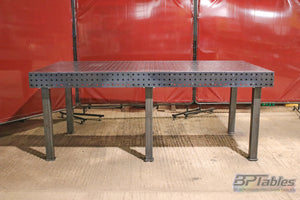
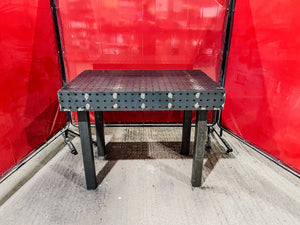
- Grid coverage: Look for 5-face coverage — holes on the top surface and all four side faces — for vertical fixturing and maximum versatility.
3. Material and Construction
The correct steel grade for UK welding table construction is S275JR to EN10025-2 — a certified structural steel with a minimum yield strength of 275 MPa. Be wary of any table that doesn't specify its steel grade. All BPT tables are manufactured from certified S275JR, sourced and cut in Somerset.
The structural design matters as much as the steel. BPT's torsion-box subframe uses 150mm-deep interlocking laser-cut ribs throughout the full depth of the table — delivering approximately 3,700× the stiffness of a solid plate of the same weight.
4. Size and Modularity
Consider the typical size of your projects. BPT offer two standard sizes: the Model S at 1200 × 800mm for home workshops and smaller fabrication setups, and the Model L at 2400 × 1200mm for professional and production-scale work. Both are designed to bolt together on any side, so you can expand over time.
5. UK Manufacture and Lead Time
Where your table is made matters — for quality control, supply chain reliability, and support. BPT tables are designed and laser cut in the South-West, UK, with standard dispatch in 5–7 working days. Compare that to 4–12 weeks for equivalent European imports.
6. Accessory Ecosystem
A precision table is only as useful as the accessories that support it. Ensure your manufacturer offers compatible clamps, stops, squares, and fixturing tools. BPT's 16mm / 50mm pitch system is directly compatible with the majority of clamping tooling already in UK workshops — no adapters required.
Maintaining Your Precision Table
- Keep it clean: Clear away welding spatter and grinding dust regularly. A clean surface prevents imperfections from affecting your work.
- Keep it oiled: A light coat of oil or WD-40 Specialist Corrosion Inhibitor is all you need. BPT tables ship with a raw oiled finish — far more effective than the thin nitrided surface treatments some manufacturers charge a premium for.
- Check periodically: Inspect the surface for any damage that could compromise flatness, and clean the fixture holes to keep tools seating cleanly.
Making the Right Choice
Investing in a precision table is one of the most impactful upgrades you can make to a fabrication workshop. The right table pays for itself quickly in reduced rework, faster setups, and consistently better results.
Not sure which BPT table is right for you? Our welding table buyer's guide covers every specification in detail — flatness, steel grade, hole systems, surface finish, and how BPT compares to European competitors.