
Walk through any premium welding table brochure and you'll find a version of the same claim: the table has been plasma nitrided, and as a result it's rust-proof, scratch-proof, and structurally superior to anything without it. These claims are driving purchasing decisions on tables that cost £3,000 to £8,000 or more. So it's worth asking: what does plasma nitriding actually do at the material level, and do these claims survive contact with the metallurgy?
We've looked at the physics carefully. The honest answer is that plasma nitriding is a legitimate surface treatment with real — but limited — benefits. The marketing language around it consistently overstates what the process can deliver, and in several cases makes claims that are physically impossible.
What Plasma Nitriding Actually Is
Plasma nitriding (also called ion nitriding or glow-discharge nitriding) is a thermochemical surface treatment carried out in a vacuum chamber. The workpiece is made the cathode in an electrical circuit. Nitrogen and hydrogen gas is introduced at low pressure, a high DC voltage is applied, and a glow discharge plasma forms around the surface. Nitrogen ions are accelerated toward the workpiece and diffuse into the metal lattice.
The result is two zones beneath the surface:
- The compound layer (also called the white layer): A thin outermost layer of iron nitride phases — primarily ε-Fe₂₋₃N and γ′-Fe₄N. This is the hard, nitrogen-rich layer that provides wear resistance.
- The diffusion zone: A deeper gradient where dissolved nitrogen atoms have diffused into the iron lattice. This contributes to residual compressive stress and a gradual hardness transition from surface to core.
The compound layer is the critical number. Published research and industrial process specifications consistently place it at 4 to 20 microns for standard industrial applications. That is 0.004 to 0.020 millimetres. A single sheet of standard copier paper is approximately 100 microns thick. The nitrided compound layer on a welding table is, at best, one-fifth the thickness of a piece of paper.
Keep that number in mind as we examine the marketing claims.
Claim: "Rust-Proof"
This is the most consequential claim because it directly affects long-term purchasing decisions. It is also the one most clearly contradicted by the underlying chemistry.
The iron nitride compound layer does have corrosion resistance superior to bare carbon steel. The iron nitride phases are thermodynamically more stable than bare iron in the presence of oxygen and moisture, and they do present a barrier to the electrochemical processes that produce rust. That part is true.
But this barrier is a 10–20 micron film on a fully ferrous substrate. The steel beneath it has zero intrinsic corrosion resistance. The moment that film is breached — by a scratch, a weld spatter impact, a dropped clamp, a tool dragged across the surface, or any mechanical event that penetrates 20 microns — bare carbon steel is exposed to the atmosphere and rust begins immediately.
Some manufacturers add a secondary oxide treatment on top of the nitride layer (effectively an admission that the nitride alone is insufficient). QPQ-treated surfaces, which add a post-oxidation step producing a magnetite layer, show improved corrosion resistance — but Fe₃O₄ is still an iron oxide. It is a barrier coating, not a passive self-repairing layer. Published research on QPQ-treated mild steel documents corrosion resistance of up to approximately 400 hours in ASTM B117 salt spray testing under controlled laboratory conditions. A working fabrication shop — with humidity cycling, condensation, cutting fluids, and daily mechanical abrasion — is not a controlled laboratory.
"Rust-proof" is not an exaggeration of what this coating delivers. It is a factually incorrect description of it.
Claim: "Deep Scratch-Proof"
Surface hardness numbers for plasma-nitrided tables are genuinely high — 450 to 750+ HV is commonly cited, and those figures are accurate. A surface at 700+ HV will resist abrasive scratching from most hand tools and light contact. That is a real benefit.
The problem is the distinction between scratch resistance and impact resistance — and most marketing conflates the two.
When a heavy workpiece is set down hard, when a clamp applies a concentrated point load, or when a piece of slag strikes the surface at velocity, the force transmits through the 10–20 micron hard compound layer into the base steel beneath it. If that base material is softer than the surface — and it always is, that is the entire point of case hardening — it deforms plastically at a stress level below what would crack the surface layer. The result is a dent in the substrate with the hard surface layer cracked or deformed along with it.
This is not a theoretical failure mode. It is the expected behaviour of any hard-on-soft layered system under impact loading. Iron nitride has high hardness but low fracture toughness — classic brittle ceramic behaviour. Hard does not mean tough. "Deep scratch-proof" implies the surface resists both abrasion and impact. The coating only meaningfully addresses one of those.
Claim: "Makes the Table Much Stronger"
Some manufacturers claim plasma nitriding increases the "loadability" of the table by 20–30%. This claim is not supported by the physics of the process.
Plasma nitriding increases surface hardness and fatigue resistance via compressive residual stress in the surface zone. These are real, well-documented effects. They are also entirely confined to the surface — the compound layer and the shallow diffusion zone beneath it.
The structural load-bearing capacity of a welding table is determined by the bulk mechanical properties of the steel through its entire cross-section: tensile strength, yield strength, cross-sectional area, and support geometry. A 25mm thick table plate has its structural properties determined by 25mm of steel. A 0.02mm surface treatment has no meaningful effect on what happens to the other 24.98mm when a load is applied.
A surface film that represents approximately 0.1% of the plate thickness cannot increase structural load capacity by 20–30%. The arithmetic does not support it.
Claim: "Spatter-Proof"
This is the one area where the marketing has a legitimate technical basis — and even here, the language overshoots the reality.
Plasma nitriding does reduce weld spatter adhesion. The iron nitride surface has lower surface energy than bare carbon steel, which reduces the wetting and bonding of molten iron droplets. This is a genuine and useful property for a welding table surface.
"Spatter-proof" implies zero adhesion. In practice, nitrided surfaces still accumulate spatter — particularly from high-energy processes or any impact event with enough force to mechanically key the spatter to the surface. A more accurate claim would be that nitrided surfaces make cleanup easier. That is true. "Spatter-proof" is not.
What Actually Works: Raw Oiled Finish
This is the approach BPT has taken from the start, and it is worth explaining why.
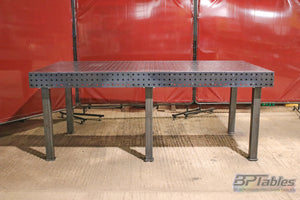
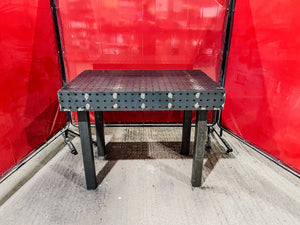
Our tables ship with a raw mild steel surface with a protective oil coating. This is not a cost-cutting measure. It is the approach that fabricators have used for generations, and it is more honest about what it is and how it works.
A light coat of oil — WD-40 Specialist Corrosion Inhibitor, Dinitrol, or similar — applied regularly provides genuine corrosion protection that you can see, feel, and refresh. When it wears off, you re-apply it. There is no brittle film to crack, no invisible breach point, no surface treatment degrading silently underneath weld spatter accumulation.
For spatter adhesion: anti-spatter spray applied before a job means weld BBs wipe off with a wire brush in seconds. The raw surface also means any surface damage is immediately visible — a dent is a dent, not a dent with a cracked coating on top of it that is now exposing bare steel from the inside out.
Independent salt spray testing has shown that a properly applied film of corrosion inhibitor outperforms nitriding alone — often by a significant margin. The difference is that a maintained oiled surface stays protected. A nitrided surface has no recovery mechanism once the compound layer is breached.
The Summary
| Claim | Verdict | Reality |
|---|---|---|
| Reduces spatter adhesion | True | Surface energy reduction is real and documented |
| Increases surface hardness | True | 450–750+ HV surface hardness is achievable |
| "Rust-proof" | False | 10–20 micron barrier on a ferrous substrate. Any breach = rust |
| "Deep scratch-proof" | Exaggerated | Resists light abrasion. Does not prevent denting from impact |
| "Makes the table much stronger" | False | Surface treatment does not alter bulk yield, tensile, or impact properties |
| "Loadability increased 20–30%" | False | Physically impossible for a 0.02mm surface treatment |
| "Maintains flatness" | False | Flatness is a bulk structural property. Surface treatment is irrelevant to it |
Final Thought
Plasma nitriding is a legitimate surface treatment technology with decades of proven application in automotive components, precision tooling, and hydraulic cylinders — applications where the surface interaction is well-characterised and the failure modes are understood.
It is not a substitute for material selection. It is not a substitute for bulk mechanical properties. And it is not, under any physically coherent interpretation, rust-proof.
If a table's marketing leads with "nitrided surface" as a primary specification, ask what it means at the material level — specifically, how thick the compound layer is and what the surface protection mechanism is once that layer is mechanically breached. The answers matter more than the headline claims.
If you want to understand how BPT approaches surface finish and why, the welding table buyer's guide covers it in full.