
Which Castors Are Best For Welding Tables?
You can build a table rated to 5,000kg, but the moment you bolt wheels to it, the castors become the limit — not the steel. We rate our tables on torsion box construction and S275 plate. No castor manufacturer rates theirs anywhere near that. So if you're putting a welding table on wheels, the castors deserve more thought than they usually get.
Here's what actually matters, and what we'd fit to one of ours.
First question: should your table be on wheels at all?
A welding table works because it doesn't move. Every bit of compliance between the tabletop and the floor shows up when you're drilling, grinding, welding or pulling a fit-up tight. Castors — even locked ones — add compliance.
If your table lives in one spot, use levelling feet. They're cheaper, stiffer, and they deal with the fact that no workshop floor is flat. Our torsion box tops don't twist to follow an uneven floor — the table stays flat regardless — but a rigid table on an uneven floor rocks on three legs instead. Levelling feet plant all four corners solid.
But most UK workshops aren't 10,000 sq ft units with a dedicated fab bay. Ours is 3,000 sq ft and the table moves when the job demands it. If that's your reality, wheels earn their place — you just need the right ones.
Load rating: divide by three, not four
The mistake everyone makes: table plus workpiece weighs 800kg, four castors, so 200kg-rated castors will do. Wrong twice over.
First, no floor is flat and no load is centred. At any given moment, three castors are doing the work — sometimes fewer. Divide your total load by three.
Second, ratings are static. Roll a loaded table over a threshold strip, an extension lead, or a weld spatter ball on the floor and the impact load on one castor spikes well past the sticker rating. Cheap castors fail here — bent forks, cracked wheels, flat-spotted treads.
Practical rule: total up your table, your heaviest realistic workpiece, and your fixturing. Divide by three. Then buy the next rating up. Overkill on castors costs £30. Underkill costs you a table that wanders, wobbles, or drops a corner mid-weld.
Plate mount, not stem
Castors mount one of two ways: a threaded stem, or a flat top plate with four bolt holes.
Stem castors are for office chairs and tool trolleys. One thread in single shear versus four bolts through plate — it's not a contest. On a welding table you want plate-mount, bolted through a proper castor pad on the leg, with nyloc nuts or thread lock. Welding the castor plate straight to the leg works too, but you'll regret it the day a bearing fails and you can't swap the unit.
Wheel material: what survives a welding shop
The floor around a welding table collects spatter, swarf, grinding dust, and oil. That kills the wrong wheel quickly.
- Soft rubber — rolls quietly, but spatter embeds in it and swarf cuts it up. Avoid.
- Nylon/plastic — fine on smooth clean floors, brittle under shock loads, deforms if parked loaded in one spot for months. Avoid for anything heavy.
- Cast iron or steel — near-indestructible, heat-proof, and rated huge. Downsides: loud, hard work to roll over rough concrete, and they'll mark a painted floor. Right answer for the heaviest setups.
- Polyurethane tread on a cast iron core — the sweet spot for most workshops. The iron core carries the load, the poly tread rolls smoothly over typical workshop concrete and shrugs off swarf and oil far better than rubber. Hot spatter will scar the tread eventually, but it stays serviceable for years.
For most people: poly-on-iron. If you're regularly loading north of a tonne, go cast iron and accept the noise.
Brakes: total-lock or don't bother
A brake that only stops the wheel turning doesn't stop the table moving — the swivel head still pivots, and the table shuffles sideways every time you lean on a drill or drag a workpiece across it. You'll be chasing your table round the workshop.
What you want is a total-lock castor: one pedal locks both the wheel rotation and the swivel. Step on, the table is planted. Step off, it rolls. Fit total-lock on all four corners, not just two — two locked castors and two free swivels still lets the table pivot.
The gold standard is a castor with a built-in levelling foot — and that's what we fit and sell, so it gets its own section.
Levelling castors: the right answer for welding tables
A levelling castor solves the wheels-versus-rigidity argument by giving you both. Each unit combines a swivel wheel with an adjustable foot pad in one body. Wind the pad down and it lifts the wheel clear of the floor — the table sits on four solid rubber feet, dead rigid, with nothing free to roll or swivel. Wind it back up and you're on wheels again.
Because each foot adjusts independently, you also get true levelling. Workshop floors are never flat — wind each corner until all four feet are planted and the table sits dead solid. No packing shims under legs, no rocking, and you can re-level in under a minute every time the table moves to a new spot.
We supply Footmaster levelling castors with our tables — the Korean firm that invented the levelling castor in 1989 and still makes the best ones. Two models:
- KGD-80F — 500kg rated per castor, 103mm overall height, 15mm of levelling adjustment. Right for the Model S and lighter setups.
- KGD-100F — 800kg rated per castor (4,800kg across six), 120mm overall height, 12mm of adjustment. The one we'd put under a Model L.
Both have cast aluminium bodies, hardened steel bearing raceways, anti-vibration axles, and NBR rubber foot pads that grip the floor and damp vibration from grinding and drilling. The pad adjusts by thumbwheel or open-ended spanner — no crawling under the table.
One thing to know about the ratings: Footmaster recommends working at around 50% of the combined castor capacity for easiest levelling. On a set of six GD-100Fs that still gives you 2,400kg of comfortable working load — more than enough for a fully loaded Model L with fixturing.
Custom laser-cut mounting plates
Footmaster plates use a 70 × 70mm bolt pattern, which won't necessarily line up with your table legs — and drilling four accurate holes per leg in position is nobody's idea of fun. We laser-cut mounting plates in-house to suit: matched to the castor's bolt pattern on one side and your leg dimensions on the other, in the same S275 plate as our tables. Bolt or weld them on, fit the castors, done. If you're putting Footmasters under one of our tables — or anything else in your workshop — get in touch and we'll cut plates to suit.
Bearings, briefly
Cheap castors run plain bores or small ball bearings — they spin beautifully in your hand and collapse under sustained heavy load. Better castors use roller bearings in the wheel, which trade rotation speed (irrelevant — you're not racing it) for far higher radial load capacity. If the castor has a grease nipple, that's usually a good sign someone designed it to be maintained rather than thrown away.
What we'd fit to a Model L or Model S
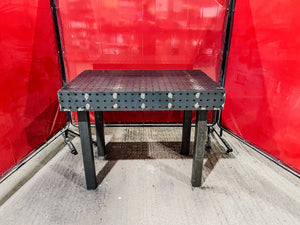
Model S (1200 × 800mm): four Footmaster KGD-80F levelling castors. 2,000kg of combined capacity is generous margin for any bench-scale job, and the levelling feet mean the table is as rigid parked as a fixed bench.
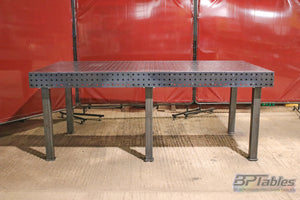
Model L (2400 × 800mm): six GD-100Fs. A big table designed to be loaded heavily needs the 800kg-per-corner rating, and over a 2.4m footprint the chance of all four corners landing on flat concrete is close to nil — independent levelling gets every foot planted, every time you move it.
Either way, we'll cut you mounting plates to suit. And whatever you fit: check the bolts after the first month. Vibration from grinding loosens castor fixings faster than anything else in the workshop.
BPT welding tables are CNC laser-cut from S275 steel and built in Somerset. We supply Footmaster KGD-80F and KGD-100F levelling castors and custom laser-cut mounting plates to suit — drop us a line.